Groin pain is a classic among people who are active in sport, but it also shows up in everyday life: sitting low, getting out of the car, or turning. The groin is an anatomical crossroads where the hip joint, adductors, abdominal muscles and tendon insertions meet. That is why a precise assessment matters: what looks like a pulled muscle may come from the hip joint, and vice versa. At BodyLab in Zurich Altstetten, we find out where your groin pain comes from and treat it specifically.

Common Cause in Active People: Hip Impingement (FAI)
Behind persistent groin pain in younger and sporty individuals, there is often a femoroacetabular impingement (FAI), colloquially known as hip impingement. In this condition, the femoral head and the rim of the socket collide during certain movements due to minor bony shape variations, typically during deep flexion and internal rotation. This irritates the joint lip (labrum) and the joint itself. Typical symptoms include pain in the groin during deep sitting, squatting, sprinting, or when changing directions, sometimes accompanied by a feeling of catching.
Important: The shape variation alone is not a problem; many people have it without any Conditions. We do not treat the X-ray image, but your actual function. Through Physiotherapy, we work on mobility, core and hip strength, as well as movement control, which can significantly reduce Conditions in many cases. Indeed, osteopathy brings its own unique perspective to the groin: it examines how the pelvis, hip, and torso interact and where movement restrictions place additional stress on the region. It is easily combinable with physiotherapy. Which path is right for you is something we will discuss during your assessment.
Other Common Causes
Adductor problems: Strains and tendon irritations on the inside of the thigh, classic in football and ice hockey. These respond exceptionally well to a targeted strengthening program.
Sportsman's groin: Overloading of the abdominal wall and inguinal canal without a palpable hernia, typical in stop-and-go sports like football. The diagnosis is made in cooperation with medical doctors.
Hip osteoarthritis: Wear and tear of the joint also frequently makes itself felt first in the groin, typically with initial movement pain and decreasing rotational mobility. Read more about this on the page hip osteoarthritis.
Overuse of tendon attachments: such as the hip flexor after unusually intense training.
Referred pain from the back: The lumbar spine can also radiate pain into the groin. The assessment will differentiate this.
How We Assess and Treat Your Groin Pain
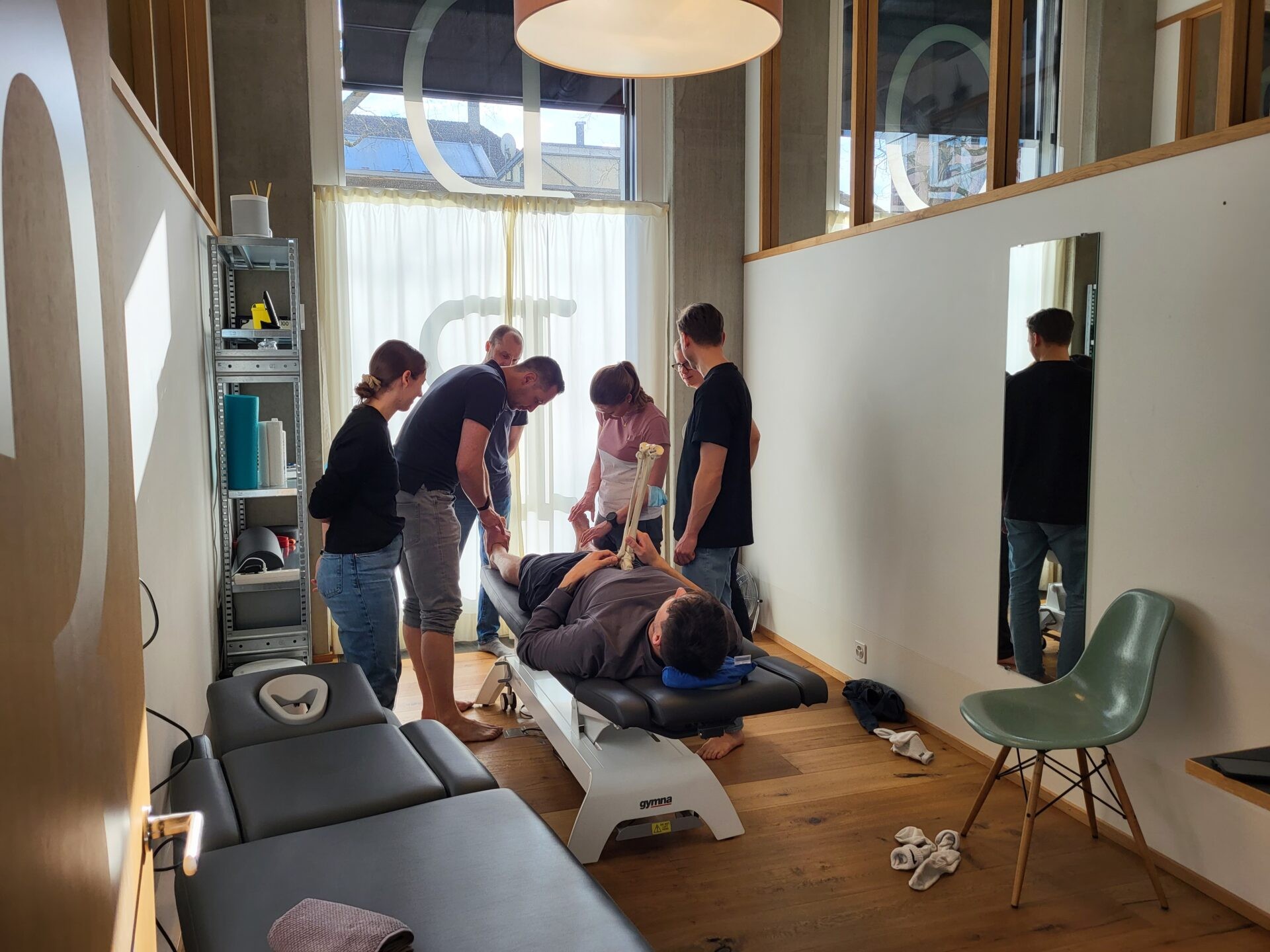
First comes the assessment: mobility tests, strength tests, and your personal history help pinpoint whether a joint, adductors, tendon attachments, or the back are behind your groin pain. Your personalized plan builds on this: manual therapy and Dry Needling for muscular issues, progressive strength building for the adductors and hip muscles, and movement control for sports and daily life. To get you back into the game, we guide you with sports physiotherapy experience and clear load-bearing criteria instead of rigid timelines. You will train directly in the practice, in our functionally equipped training area.
Urgent? We've got you covered with same-day appointments.
Acute pain doesn't wait around.
That's why we get you an appointment at short notice, often on the very same day. Book online or give us a call:
When to consult your doctor
Hip pain is rarely dangerous. However, seek immediate medical evaluation if you experience any of these signs:
Hip pain following a fall, especially if you cannot bear weight on your leg: a fracture must be ruled out first
Fever accompanied by sudden, severe hip pain: a potential sign of a joint infection
Hip pain in children and adolescents, particularly when accompanied by a limp: growth-related conditions must be ruled out
A painful bulge in the groin that cannot be pushed back, especially when accompanied by nausea: a potential incarcerated inguinal hernia, which is a medical emergency
These signs are rare. If none of these apply to you, there is absolutely nothing standing in the way of your successful treatment with us.
Who covers the cost? Let's talk investment in your future.
Physiotherapy is covered by basic insurance with a doctor's referral, or after an accident by accident insurance or your health insurance's accident coverage. You can book osteopathy directly, without a referral; most supplementary insurance policies for alternative and complementary medicine contribute to the costs, and depending on the insurer, this also applies after an accident.
It is best to clarify directly with your insurance provider beforehand how much they will cover.
Whether it is Physiotherapy or osteopathy: you are always welcome as a self-payer, and this does not change anything about your treatment.
You can find the cost of your treatment under Rates and cost coverage.
For active individuals, the adductors, hip flexors, and the hip joint itself are the most common sources of discomfort, and they each feel distinct: the adductors flare up on the inside of the thigh when bringing the legs together or after sprinting and kicking; the hip flexors react at the front when lifting the knee; while the joint itself causes deep groin pain during deep sitting, squatting, or twisting—often accompanied by a catching sensation typical of hip impingement. Persistent groin pain that returns even after a rest period points more toward a joint issue. From midlife onwards, hip osteoarthritis also frequently presents first in the groin, characterized by initial stiffness and reduced rotational mobility. A precise diagnosis differentiates these causes from back issues or a hernia.
Which path is yours to conquer?
Three quick questions, and you'll know exactly where to start. Immediate support needed? Call us: 044 545 03 03