The Essentials
Fascinating Fascia

For about 10 years, the anatomical structure known as fascia has been on everyone's lips. Fascia rollers, fascia balls, fascia massage, fascia distortion model (FDM), fascia yoga, etc... but what exactly are these fasciae?
Fasciae are a connective tissue matrix that wraps around all our bodily structures (muscles, ligaments and joints, bones, nerves, blood vessels, and organs) like packaging. As a result, fasciae give us our shape (body) and serve as the first layer of protection against external forces.
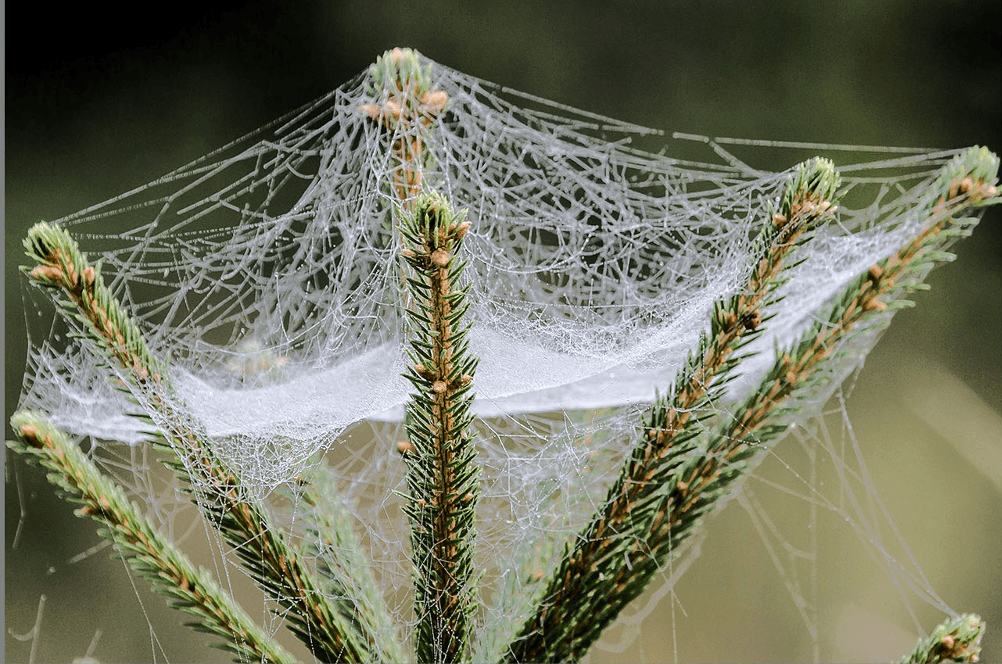
Frank Liebig creator QS:P170,Q29586018, Cobweb in fir tip, CC BY-SA 3.0 DE
Structure of the Fasciae
The body fascia can be divided into four different layers. The outermost layer just under the skin forms the panniculus fascia, often referred to as the superficial fascia. The panniculus fascia consists mostly of loose connective tissue and fat and covers our entire body (torso, arms, and legs) except for body openings such as the mouth, eyes, nose, etc.
The second layer is formed by the deep fascia (deep fascia or muscle fascia). Like the panniculus, the deep fascia develops from the embryonic mesenchyme. It forms the primitive matrix in which all skeletal muscles, bones, tendons, ligaments, and joints develop during embryonic development. In the arms and legs, the deep fascia is usually called muscle fascia – but the function remains the same: the dense mesh-like connective tissue serves as a protective and sliding layer for the musculoskeletal system and transmits part of the force to the joints during muscle contraction.
The third and fourth fascia layers are enclosed by the deep fascia and are referred to as meningeal and visceral fascia. The meningeal fascia encloses and protects our nervous system, while the visceral fascia acts as protection and suspension for our internal organs.
It is important to note here that these four layers should not be viewed as individual systems, but as a unified continuum of tissue structures.
The body fasciae, like joint capsules and intramuscular and intraneural septa, belong to the unformed (mesh-like), dense connective and supporting tissue of our body. Tendons and ligaments, on the other hand, consist of formed (parallel-fiber) connective tissue. The difference lies in the arrangement of the collagen fibers in the tissue – in response to tension acting in different directions, the collagen fibers in the unformed, dense connective tissue form networks that can also shift and unfold in different directions. In formed connective tissue, all fibers are always aligned in the same direction – they run parallel to each other due to the constant, identical stress. Therefore, fasciae are much more flexible and mobile compared to ligaments.
Fundamentally, unformed and formed connective tissue consist of the same building blocks – cells and extracellular matrix. The cells are divided into fibroblasts/fibrocytes, chondroblasts/chondrocytes, and osteoblasts/osteocytes. Which type of tissue the connective tissue develops into depends on the mechanical demands placed on the tissue and the mesenchymal cells, respectively.
If tensile forces act predominantly on the tissue, fibroblasts develop for the most part, which in turn produce predominantly type I collagen fibers and very little elastic ground substance, meaning tendons and ligaments develop. However, if pressure is the main force acting on the tissue, chondroblasts develop for the most part, producing exclusively ground substance and only very thin type II collagen fibrils. This is basically what you find in hyaline articular cartilage.
In fascia tissue, fibroblasts develop designatively. However, these contribute only a small portion to the volume of the fascia, but they play an important role in the build/structure as well as in fascia stiffness. The tasks of fibroblasts are to produce most of the components that make up the extracellular matrix – with the exception of the abundant water in the fascia – as well as to repair tissue damage during wound healing.
In addition to fibroblasts, adipocytes (fat cells) are also found in the fascia tissue. Adipocytes not only play an important role in estrogen production, but are also important producers of various peptides and cytokines, which are responsible for appetite, insulin, and blood sugar regulation as well as for angiogenesis (growth of blood vessels), vasoconstriction (vascular narrowing), and blood clotting – crucial substances during wound healing. In the fascia, adipocytes are dense and numerous in areas with high shear forces and sliding movements, where they serve as cushioning.
Research has revealed that there are many different types of receptors within the fascia. These include myelinated proprioceptive receptors as well as a variety of unmyelinated "free" nerve endings. These nerve endings deliver vital signals to our brain for the control of movement and posture (proprioception), where conscious and unconscious perception of posture and movement is formed using information from other sources in our body. If you look at the number of receptors in fascia tissue, it is probably just as large, if not larger, than the number of receptors in the retina (of the eye). It is easy to see, then, that fascia is one of our most important sensory organs!
French hand surgeon Dr. Jean-Claude Guimberteau has provided us with an effective overview of the structure and function of fascia. Intraoperatively, he used an endoscope to examine how the fibers of the fascia move and behave. In his film "Strolling under the skin", you get a wonderful glimpse beneath the skin.
"PROMENADES SOUS LA PEAU OU A la découverte des architectures de la matière vivante", Dr. Jean-Claude Guimberteau
Role & Function of the Fasciae
In addition to its role as a sensory organ, the fascia must be able to deform very quickly in different directions and planes and immediately return to its original shape – because the fascia acts as the first protective shield against external forces. Our muscles, bones, and joints generally cannot handle too much direct contact without sustaining damage. To prevent muscle injuries in particular (e.g. muscle fiber tears), the fascia must immediately act as a shock absorber during large, rapid impacts, as the muscles themselves react too slowly to prevent an injury.
One-sided, one-dimensional movements can lead to adhesions in the fascia. These are known as crosslinks. As a result, the fascia loses some of its glidability. Consequently, as in the case mentioned above, the fascia can no longer absorb the entire force, and a muscle fiber tear can occur.
In addition to its function as a protective sleeve, the fascia, due to its layered arrangement, serves as a sliding and shifting layer. You can imagine that individual nerves, arteries, veins, muscles, and even muscle groups are enveloped and separated from each other by fascia. The fascia thus enables movement between the individual structures in our body.
Furthermore, this architecture of the fascia supports the muscles in transmitting force between muscles, muscle groups, and joints during movement and sports – we work in what are called myofascial chains. These chains are named differently by different authors, but they all have one thing in common: every muscle group needs a base to perform its function. This base consists of other muscle groups, which in turn are stabilized by further muscle groups, etc. Certain types of therapy are based on the theory of myofascial chains, such as proprioceptive neuromuscular facilitation (PNF) by Dr. Herman Kabat. This is a method for treating muscle paralysis in poliomyelitis. The idea here is that paralyzed muscles are activated in cooperation with/via other muscle chains.
Therapy
Why is fascia treatment so important and efficient? Imagine the fascia system as four layers of tights, one over the other, with grown-in nerves, blood, and lymph vessels. To allow movement, these four layers of tights must be able to slide freely against each other in all directions. When crosslinks occur between the layers, it not only restricts mobility, but also has a direct impact on the nervous, circulatory, and lymphatic systems.
If you now bunch up the tights on the calf with your hand, as is the case, for example, with scar formation after surgery in the fascia tissue, you can easily observe how far the tension pulls the tights. Therefore, it is not surprising that if you have an injury/restriction/scar, these can cause problems across other joints in another part of the body.
When dealing with pain or restrictions of the musculoskeletal system, the goal of a physiotherapist and osteopath is to identify which structure holds the blockage, this reduced mobility, in order to then apply a custom-tailored technique so that the restrictions and pain are positively influenced and the tissue can return to its normal state.
New studies seem to prove that fasciae can contract and play an important role in force development and transmission [1,2]. In addition, together with muscles, tendons, and joints, they serve as an absorption mechanism for fast-acting forces. From our understanding, fasciae must therefore also be considered and treated in the overall context of muscles. Based on the complaints, the focus of training and therapy can be placed on specific structures, but as mentioned, these are strongly linked to one another so that the entire body is always trained. Manual therapeutic measures for treating fascial and muscular problems include fascia/connective tissue massage, myofascial release, FDM, trigger point and dry needling therapy, PNF, stretching, fascia rolling, etc.
Fascia Training
Fasciae can and should be trained together with the entire musculoskeletal system to ensure glidability and functionality. However, in our opinion, it is very difficult to train the fascia in isolation due to its anatomy and function: you are training the entire neuro-muscular system. Crucially, however, work should be done in all dimensions, and you shouldn't just perform one-sided movements. Training methods like Pilates and Yoga are therefore excellent, but jumps, like jumping rope, are also helpful. High Intensity Interval Training (HIIT) also lends itself well to fascial training methods. With HIIT, however, the joints are put under more stress than with Yoga and Pilates, which is why we recommend this form of training with the support of a physiotherapist or personal trainer, i.e., under guidance.
" Fascia - The Mysterious World Under the Skin", all rights reserved by arte.tv
If you need us, we are always here for you!
Your BodyLab Team, your team for all things fascia and flexibility
Osteopathy and Physiotherapy | Rehabilitation and Training
Zurich Altstetten
Bibliography
Zügel M,Maganaris CN, Wilke J, et al.
Br J Sports Med 2018;52:1497.
[2] Are muscles mechanically independent?
Robert D. Herbert, Phu D. Hoang, and Simon C. Gandevia
J Appl Physiol 104: 1549–1550, 2008; doi:10.1152/japplphysiol.90511.2008.
Header Image Credit
anonymous, Garden spider, web in backlit, marked as public domain, details on Wikimedia Commons