The Essentials
The Action Potential - All or Nothing
As described in our previous blogs (Nerves, Pain Transmission), signals such as pain are generated and transmitted by our nerve cells and interpreted in the brain. But how exactly does this signal generation work? How does our body achieve this?
This occurs through electrical potential differences and is an incredibly exciting and fascinating process:
The Resting Membrane Potential
In the watery environment of our body, there are ions (charged atoms). These can form spontaneously when salts (e.g., table salt: sodium chloride NaCl) are dissolved in polar solvents (like water H2O). This creates positive anions (in the case of table salt NaCl, sodium ions Na+) and negative cations (chlorid ions Cl-). Proteins also become negatively charged cations in a watery environment.
So, we have positive and negative electrically charged particles inside of us.
To keep it simple and brief, here are some key ions and facts about their distribution in the human body:
Negative protein ions are found mainly INSIDE the cell
Positive potassium ions K+ are also found mainly INSIDE the cell
Positive sodium ions Na+ are found mainly OUTSIDE the cell
This distribution, among other things, creates a voltage difference in all cells with a negative charge between the intracellular space (ICS, inside the cell) and the extracellular space (ECS, outside the cell).
This is known as the resting membrane potential (or equilibrium potential).
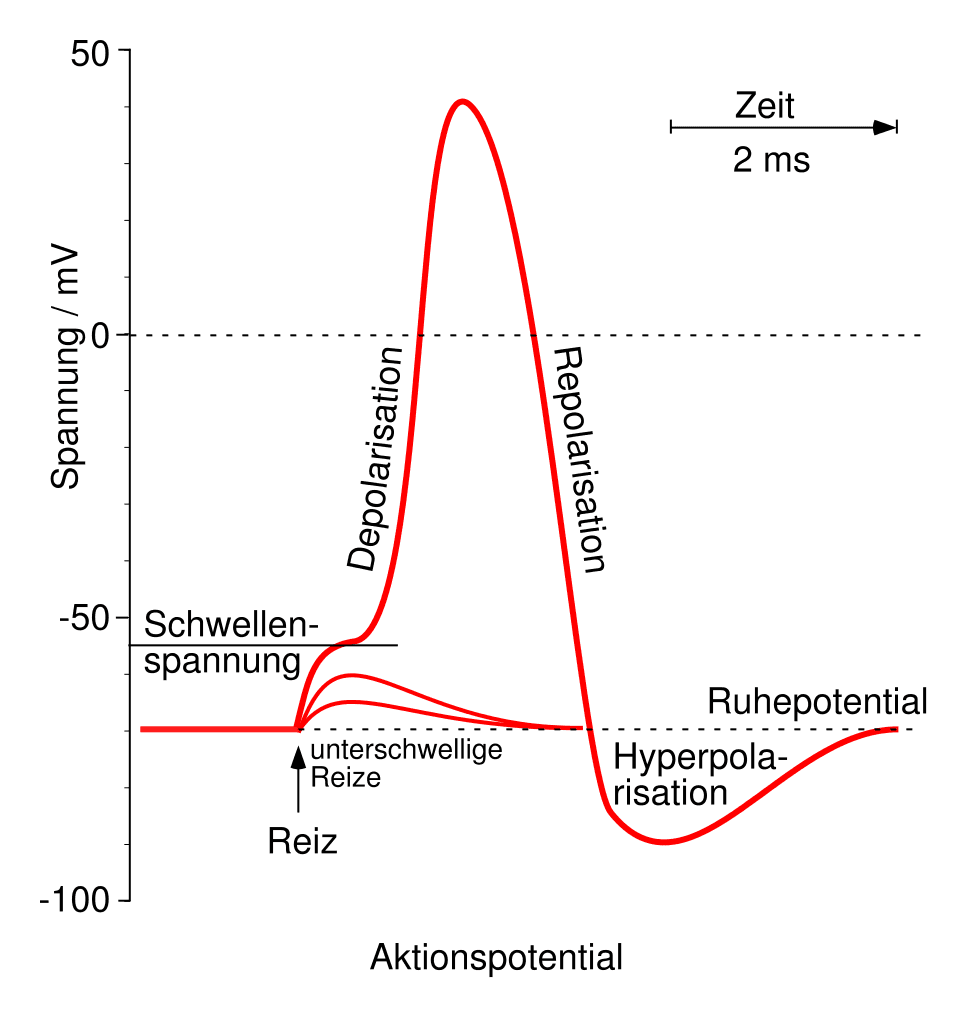
The magnitude of this resting potential varies between different cell types. In nerve and muscle cells, it is approximately -70 to -90 mV.
Author Action_potential.svg: Original by en:User:Chris 73, updated by en:User:Diberri, converted to SVG by tiZom, Copyright (C) 2000,2001,2002 Free Software Foundation, Inc. 51 Franklin St, Fifth Floor, Boston, MA 02110-1301 USA Everyone is permitted to copy and distribute verbatim copies of this license document, but changing it is not allowed.
The Action Potential
An external stimulus (such as a neurotransmitter or electrical signal to the dendrites) changes the permeability of a neuron's cell membrane—first to sodium, and shortly after to potassium ions. Channels open, and diffusion processes take over:
Since there are almost no sodium ions inside the cell, these positive Na+ ions rush (first) into the ICS, changing the intracellular polarity. This causes a depolarization of the cell. If the stimulus is strong enough to exceed the threshold voltage (stimulus threshold) of approximately -55mV, complete depolarization of the nerve cell occurs. This results in an action potential (with an overshoot) and an all-or-nothing response from the nerve cell, causing the voltage between the ICS and ECS to spike briefly to about +20mV!
The sodium channels for the Na+ influx then close once again.
The electrical signal of the action potential is propagated along the axon of the nerve cell.
Note: This action potential—the triggering of a nerve cell signal—is only initiated if the neuron's stimulus threshold (approx. -55 mV) is exceeded. If the threshold is not reached, a slight depolarization still occurs, but not according to the all-or-nothing principle, and thus without an action potential! Consequently, no signal is triggered or transmitted.
Repolarization and Hyperpolarization
During the subsequent repolarization phase, the abundant potassium ions continue to flow out of the cell (where there is little K+) through channels that remain open longer than the sodium channels. This leads to hyperpolarization (to approximately -100mV) after an action potential.
Active processes utilizing Na-K pumps then restore the original distributions (pumping Na+ into the ECS and K+ into the ICS), relatively quickly returning the membrane to its resting potential of -60 to -90 mV.
This hyperpolarization makes immediate re-stimulation and triggering of another action potential much more difficult (Note: the stimulus threshold must be reached to trigger an action potential). Any incoming stimulus would have to be stronger than a normally sufficient one, which is virtually impossible through normal anatomical means! There are no bodily stimuli that can excite a cell in this hyperpolarized state.
This mechanism ensures that a membrane cannot be immediately excited again, causing the electrical signal on the membrane to travel in only one direction (unidirectionally) along the axon! This also acts as a feedback protection mechanism. The action potential must and will be driven in one direction.
All of this happens in an incredibly fast 1-2 milliseconds. After all, a nerve must be ready for excitation again as quickly as possible to transmit further signals. This is only possible when both the action potential and hyperpolarization occur rapidly!
Whenever you need us, we are here for you!
Your BodyLab Team, your specialists for physical complaints
Osteopathy and Physiotherapy | Rehabilitation and Training
Zurich Altstetten
Cover Image Credit
Action_potential.svg: Original by en:User:Chris 73, updated by en:User:Diberri, converted to SVG by tiZom, Copyright (C) 2000,2001,2002 Free Software Foundation, Inc. 51 Franklin St, Fifth Floor, Boston, MA 02110-1301 USA Everyone is permitted to copy and distribute verbatim copies of this license document, but changing it is not allowed.