Back
Holistic Thorax Examination and Treatment

During one of our internal continuing education sessions here at BodyLab Osteopathy and Physiotherapy | Rehabilitation and Training in Zurich, we took a deep dive into the topic of "holistic thoracic examination and treatment."
A restriction or dysfunction of movement in the thoracic area can trigger a wide variety of issues, either causing localized problems or pain (for example, in the thoracic spine (T-spine) or along the ribs) or radiating out to other areas (like the arms, neck, and head). This often happens due to the biomechanical connections of all the involved joints: as an example, when you turn your head, not only does the cervical spine (C-spine) rotate, but the thoracic spine down to about the 4th thoracic vertebra (T4) also moves in tandem in the direction of the rotation.
Even during maximum arm elevation, the final degrees of shoulder movement must be supported by extension in the thoracic spine, as the shoulder joint alone cannot reach its full range of motion. If the spine or an involved joint fails to provide this support, it can lead to overloading of the involved joints resulting in pain, symptoms, and/or restricted movement.
Anatomical Conditions
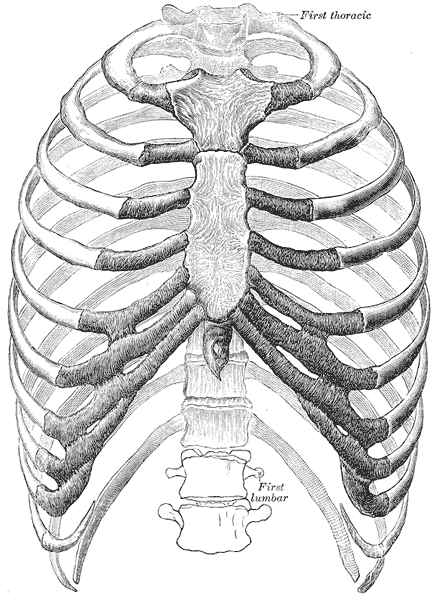
To kick things off, we went deep into the theory, examining and discussing the different components of the thorax and their functions. The thorax consists of the thoracic spine, the ribs, the sternum, the intrathoracic fascia, and the diaphragm.
Thoracic Spine and Ribs
The thoracic spine is made up of 12 thoracic vertebrae and forms an anatomical kyphosis. The twelve ribs can be divided into usually 5-6 sternal (true) ribs, which are attached directly to the breastbone (sternum) via cartilaginous connections, 4 asternal (false) ribs which connect to the other ribs at the costal arch via cartilage, and 2 floating ribs.
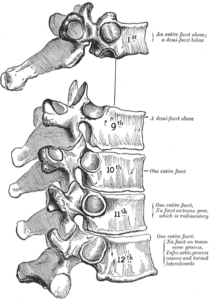
Each rib is connected to the thoracic spine via 2 different synovial joints (depending on the level, either with a single vertebral body or with two different vertebral bodies and the intervertebral disc in between) as well as to the transverse process of a thoracic vertebra.
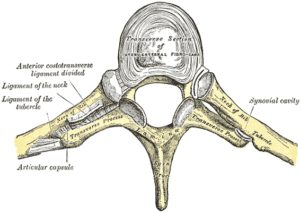
Even though we use our ribs with every single breath and they must move along with every motion of the thoracic spine, we rarely realize how complex this entire system is and how many joints are involved. However, anyone who has ever experienced a blocked, poorly functioning rib knows exactly how disruptively painful this can be!
Sternum and Manubrium
The sternum consists of three key components: the manubrium sterni, the body of the sternum (corpus sterni), and the xiphoid process (where the diaphragm attaches).
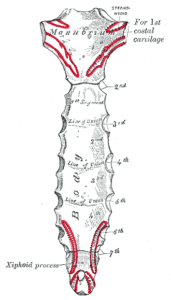
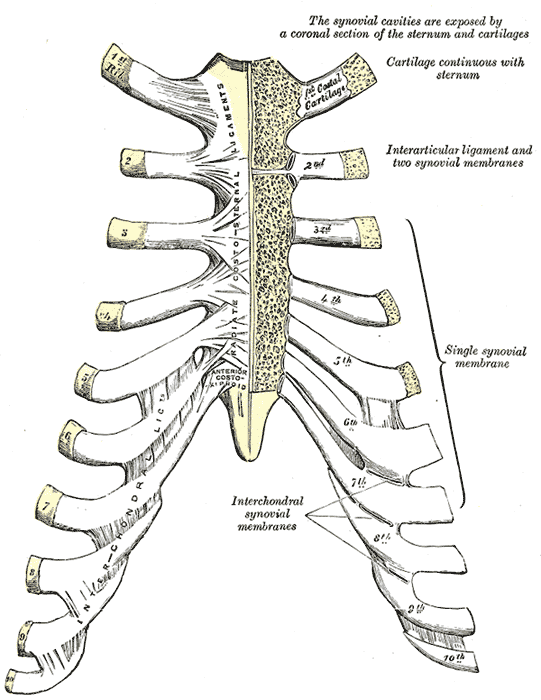
This can be easily observed on our skeleton model and is also easy to palpate on yourself. The second rib can always be found right at the junction where the manubrium meets the body of the sternum.
Diaphragma
The diaphragm, a powerful muscle, stretches across the lower costal arch (arcus costae) and is also attached to the spine.
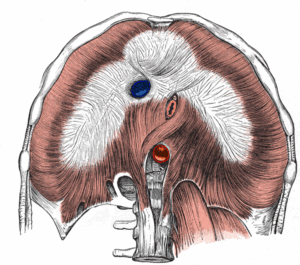
It became crystal clear to us once again how crucial the diaphragm is and what a massive impact it can have on the skeletal system, among other things. And yet, this vital muscle is so often overlooked in therapy. Fortunately, there are several regions and areas where the diaphragm is highly accessible—both directly and indirectly—and ready for manual therapy interventions!
Intrathoracic Fascia
Among the most important intrathoracic fascia are the pleura and the pericardium, which can be further subdivided and differentiated anatomically. They attach to the spine (pleura, C6/7), the cervicothoracic junction (CTJ, vertebropericardial ligament of the pericardium), and the manubrium or body of the sternum / diaphragm (superior and inferior sternopericardial ligaments). The structures of the thorax are linked through the fascial system, making it completely logical that tension here can transfer to and cause issues within the skeletal system.
We immediately put this into practice by palpating and feeling these structures on one another. It is always incredibly exciting to swap roles and experience things as the "patient." In our view, one of the most critical aspects of manual diagnostics is sensing and interpreting the end-feel. The end-feel provides vital clues about which tissues are not moving or functioning correctly.
We took plenty of time, and with the support of our experienced therapists and osteopaths, we practiced on each other, feeling, sensing, and comparing the end-feel and tension patterns of different team members.
Due to all of these biomechanical connections and the interplay between different body parts, organ fascia, and structures, treatment might not happen directly at the source of the pain point, but rather at another, more distant location. For instance, shoulder pain might be treated at the front near the sternum (breastbone), which in turn minimizes the pain in the shoulder. However, this requires a profound knowledge of human anatomy and represents the true mastery of diagnostic interpretation.
This training session reminded us once again that we must always look at the body as a whole. After all, these connections explain perfectly why discomfort can return if the underlying, root causes are left untreated. These internal training sessions also provide the perfect space for inspiring discussions and exchanging experiences—something we actively cultivate and promote at BodyLab. It is also a fantastic opportunity to grow together as a team and connect outside of the usual routine. This pushes us forward as therapists and elevates our practice, which ultimately benefits our patients and clients. After sessions like these, you walk away inspired and motivated to try out and apply new techniques, skills, or perspectives. And in true BodyLab style, a demanding, high-energy training session is always followed by a dinner together….
Thanks to our diverse team of specialists, BodyLab is perfectly equipped to tackle any challenge.
If you need us, we are here for you!
Your BodyLab Team, your experts for a free-moving rib cage
Osteopathy and Physiotherapy | Rehabilitation and Training
Zurich Altstetten
Title Image Credit
anonymous, Vesalius 164frc, marked as public domain, details on Wikimedia Commons