Back
Disc Structure & Function

Your intervertebral disc (Discus intervertebralis) has a round, elliptical structure. It is located between all vertebral bodies from C2-C3 down to L5-S1. In young people, it is a white, gel-like, and translucent structure. Over the years, like all collagenous structures, it takes on a more yellowish-brown color and gradually loses its elasticity, flexibility, and load-bearing capacity.
Role and Function
The role of the intervertebral disc is diverse:
First of all, it absorbs compressive and shock forces acting on your spine.
Furthermore, it allows for mobility between the individual vertebrae. The thickness of the disc appears to help determine the extent of movement between two vertebrae, whereas the facet joints determine how the movement takes place.
And last but not least, the disc keeps your spinal ligaments under tension. In doing so, it ensures and enhances the stability of your spine.
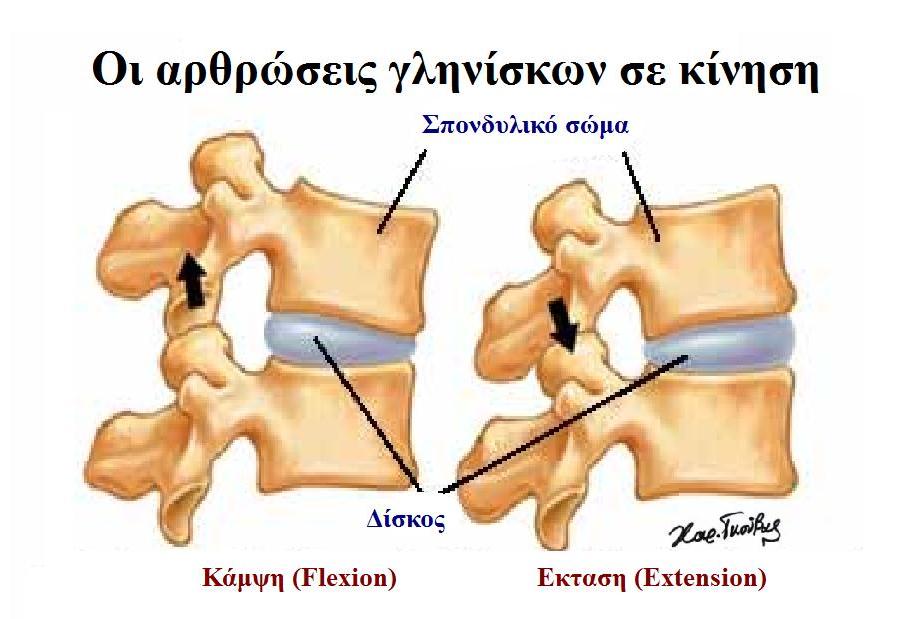
Harrygouvas at Greek Wikipedia, Facet Joints Motion, CC BY-SA 3.0
Structure
An intervertebral disc changes markedly and very clearly over the years through growth and aging. It is divided into a fibrous outer part (annulus fibrosus) and a watery inner core (nucleus pulposus). At birth, the disc still consists half of the nucleus with few collagen fibers, while the outer half is structured with many collagen fibers in different rings. However, this distinct separation of nucleus and annulus disappears during growth. The disc develops into a more homogeneous fibrocartilaginous structure.
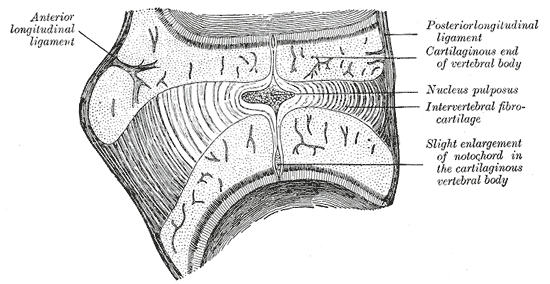
Henry Vandyke Carter Henry Gray, Gray66, marked as public domain, details on Wikimedia Commons
Biomechanically, the outer regions of the disc are increasingly subjected to tensile stress, while the inner region is subjected more to pressure and compressive stress.
The disc is in contact with the endplates of the adjacent vertebral bodies on both sides. These endplates initially consist of hyaline cartilage. Over the years, however, they begin to calcify and ossify, starting from the vertebral bodies. There is still an ongoing debate about whether the endplates belong to the disc or to the vertebral body. In spinal injuries, however, it is often seen that the endplates have a firmer connection to the disc than to the vertebral bodies.
The disc's ability to bind water is enormous due to the negative charge of the proteoglycans and glycosaminoglycans in its ground substance. Thanks to this strong water-binding capacity, the collagen network is kept under tension, creating great stability and resistance to deformation.
It is also remarkable that the ground substance cannot fully exhaust its maximum capacity to absorb water, as this is prevented by the collagen network. We will come back to this point later.
What Your Intervertebral Disc Needs
As already mentioned, only a small outer portion of the disc has a blood supply. However, recent studies show that it is also amply supplied with oxygen and nutrients via diffusion and osmosis. Consequently, it is capable of regeneration and healing throughout its entire structure!
Transport mechanisms are supported and promoted by changing positions (under the effect of gravity), movement, or training: When compression from gravity ceases (e.g., when lying down), the disc fills with fluid (hydration). When gravity acts again, fluid is squeezed out of the disc (dehydration). A similar process naturally occurs with increased load followed by relief!
Due to the progressive ossification of the endplates with age, the transport processes (diffusion and osmosis) for nourishment become increasingly poorer. As a result, the disc receives fewer and fewer nutrients, especially in the less vascularized areas.
Another problem is the very long turnover time of collagen, which is between 300 and 500 days. Regeneration into high-quality disc tissue is therefore a long and sometimes arduous journey.
With increasing age, your body also loses the ability to bind water. That is why, especially in young people, a difference in height can be observed in the morning after sleeping, as the discs have expanded and enlarged slightly.
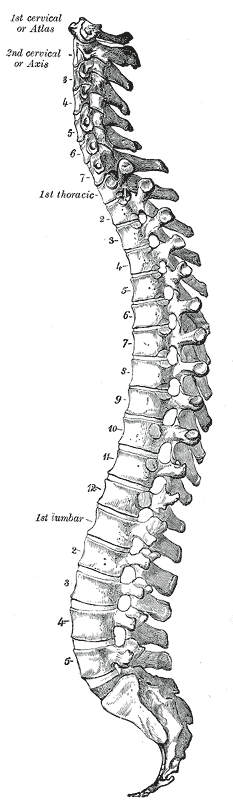
Henry Vandyke Carter Henry Gray, GA111, marked as public domain, details on Wikimedia Commons
What Effect Does Training Have?
Alternating between loading and unloading creates a constant change in electrical voltage within the disc. This shift in charge causes piezoelectric activity (piezoelectricity: change in electrical polarization and thus the appearance of an electrical voltage in solid bodies when they are elastically deformed, Wikipedia). For the cells, this piezoelectric voltage acts as a trigger for synthetic activity to produce more ground substance material (see also our blog post on connective tissue). In addition, the mentioned transport mechanisms of diffusion and osmosis work optimally through the constant change between loading and unloading, supplying the disc with necessary building blocks (amino acids, glucose, etc.) and removing waste products.
Due to the forces acting on the collagenous structures and fibers during movement, these also become qualitatively better and more resistant.
So, as is usually the case in the human body, movement and training have a positive influence on the physiological functions of your discs.
We will discuss common disc problems and therapy options in another blog post.
Once again: Life means movement!
Whenever you need us, we are here for you!
Your BodyLab team, your specialists for a strong, flexible back
Osteopathy and Physiotherapy | Rehabilitation and Training
Zurich Altstetten
Find out more on our page about herniated disc.
Cover Image Credits
Henry Vandyke Carter Henry Gray, Gray66, marked as public domain, details on Wikimedia Commons