The Essentials
Synapses - The Connection of Our Nerves

At the end of a neuron's axon, the action potential reaches the synapse.
The synapse (terminal bouton) consists of the presynaptic membrane (at the end of the axon), the synaptic cleft (filled with extracellular fluid), and the postsynaptic membrane (e.g., dendrite, muscle cell).
It forms the point of contact with another neuron (dendrite), a muscle cell, or a gland cell / organ.
The synapse therefore represents a connection between two excitable cells. It converts electrical stimuli (from the nerve cell) into a chemical messenger (neurotransmitter), which in turn triggers an electrical impulse and either inhibits or depolarizes the postsynaptic cell!
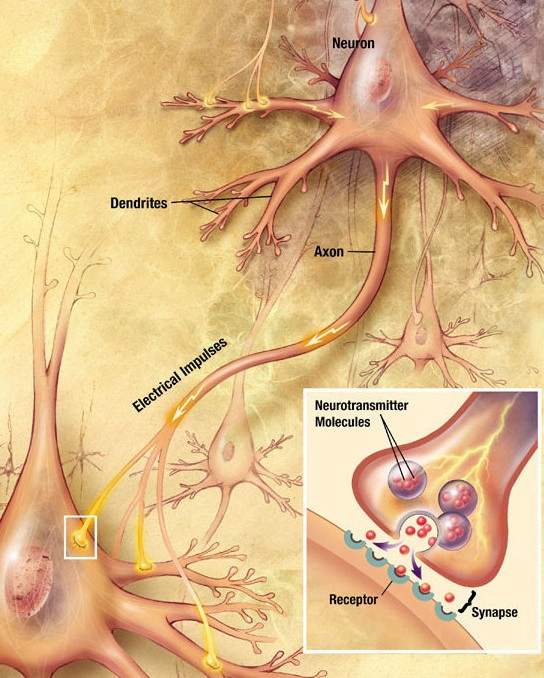
Chemical synapse schema cropped, marked as public domain, details on Wikimedia Commons
Synapses – Electrical signal transmission, chemical communication
The action potential is conducted from the cell body along the axon, which, as you know, can be very long. The better insulated the axon is, the faster this transmission of stimuli works—in fact, that is how it works over long distances at all.
We have nerves with varying thicknesses of myelin and consequently different nerve conduction velocities (better insulation means faster transmission). This offers distinct advantages, as you will see later or in another blog post!
The electrical action potential triggers the release of neurotransmitters stored in vesicles within the synapse, in combination with Ca+. These neurotransmitters diffuse across the synaptic cleft, where they trigger another reaction—such as a renewed depolarization of a nerve cell or a muscle cell (followed by muscle contraction).
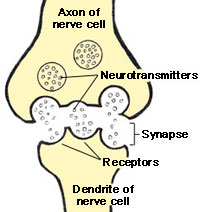
anonymous, Chem. Synapse scheme, marked as public domain, details on Wikimedia Commons
A neuron specializes in a specific function and therefore in specific neurotransmitters! This means it primarily uses one specific neurotransmitter to trigger an effect. Neurotransmitters are specific to particular receptors—think of it as a lock-and-key principle.
These neurotransmitters are divided into excitatory or inhibitory substances: excitatory ones cause the signal to be transmitted further (e.g., acetylcholine in motor transmission), while inhibitory ones stop the transmission, effectively blocking and shutting off the signal.
Inhibitory neurotransmitters at the postsynaptic membrane only affect the conductivity of K+ channels (see our blog on the action potential): Due to the K+ efflux (outflow from the inside of the cell), the already negative cell interior becomes even more negative, and the membrane is hyperpolarized! As a result, no further immediate excitation via impulses is possible! This is known as an inhibitory postsynaptic potential (IPSP, shifting from -70 to -100 mV during inhibition). In this moment and state, the membrane cannot be stimulated!
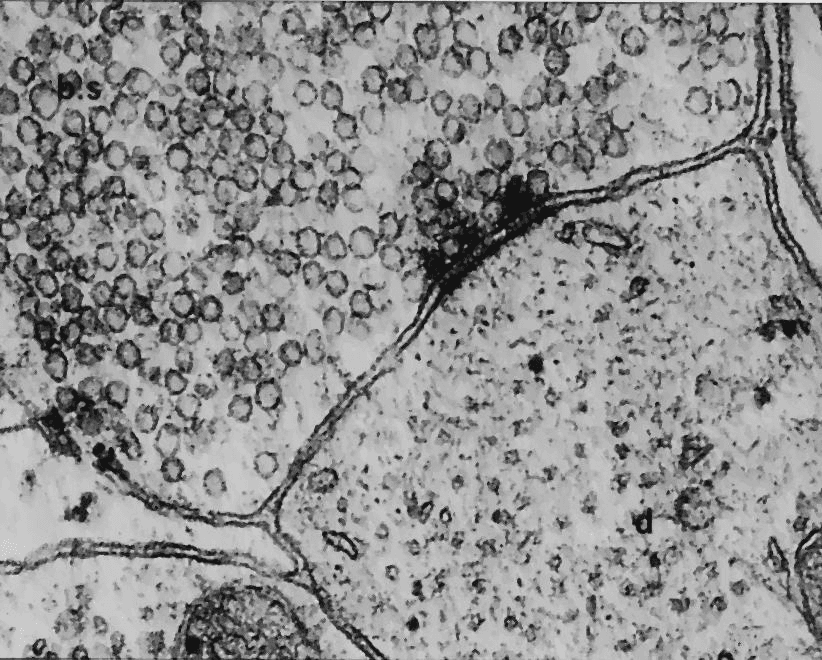
Savant-fou, Synapse neuro-neuronale, CC BY-SA 3.0
Neurotransmitter Production
Neurotransmitters such as acetylcholine (a transmitter in motor transmission) are produced in the cell body (in this case, from choline and acetyl). Acetyl is a substance produced in your mitochondria during the citric acid cycle—a metabolic cycle that generates energy using oxygen. Thanks to this continuous production, it is abundantly available. Choline, however, is not available to the body in such large quantities.
The completed neurotransmitters are packaged into granules or vesicles (small bubbles) and transported along the axon to the synapses, where they are stored, ready for release.
After being released into the synaptic cleft, neurotransmitters are quickly broken back down into their original components by specific enzymes (e.g., acetylcholinesterase in the case of acetylcholine). The breakdown products are either washed away with the bloodstream (e.g., acetyl) or reabsorbed into the synapse (such as choline, which is not as abundant as acetyl). From these—after being transported back to the cell nucleus—new neurotransmitters are synthesized once again.
A rapid breakdown of released and active neurotransmitters is crucial: Action potentials often arrive in rapid succession (1–2 ms, as you saw in our previous blog), and these signals need to be transmitted cleanly.
On the other hand, continuous exposure of a muscle cell to acetylcholine would lead to a permanent muscle contraction.
Diseases and Pathologies
It is also important for you to know that these neurotransmitters, like all substances, are produced by the nerve cell itself within its cell body. The entire axon is also supplied with its own vessels and transport pathways from the cell nucleus. However, this also means that substances have to be transported the entire, long way from the cell body to the synapse!
This is where problems can arise in various pathologies: If, for example, pressure (such as from a herniated disc) is exerted on the cell body of a motor neuron located in the spinal cord, the production of these neurotransmitters is disrupted. This can lead to symptoms of paralysis.
If a structure presses directly on the axon instead, blood circulation to it (including the axonal transport of the transmitters packaged in vesicles) is impaired. This can cause pain and paresthesia, or, with greater pressure, motor deficits as well.
This also helps you understand why pressure on an axon may be very painful, but not always as catastrophic as pressure directly on the cell nucleus: If the cell nucleus dies (which can happen in a relatively short time and is a medical emergency), the entire neuron fails. However, as long as the necessary substances and building blocks can still be produced in the cell nucleus, there is a chance for regeneration and recovery of the neural structures.
Poisoning and the Effects of Toxins
Another challenge is competitive inhibition by other substances: It is called competitive because there are molecules whose structure and shape fit the receptor better (having a higher affinity) than the actual neurotransmitter! This substance has no active effect of its own, but it occupies the receptor, preventing the neurotransmitter from docking—and consequently, no reaction is triggered!
This happens, for example, with carbon monoxide (CO) poisoning (smoke gas inhalation): The gas binds much better to hemoglobin (higher affinity) than oxygen does. This blocks the transport of oxygen through your blood, which can have fatal consequences.
This mechanism of competitive inhibition is also frequently utilized in insecticides, preventing neurotransmitters from docking.
Another possibility is an inhibitory effect on acetylcholinesterase (the enzyme that breaks down acetylcholine), as seen with nerve agents like sarin gas. This results in a continuous contraction of the muscles, which has fatal consequences due to its impact on your respiratory system.
Training and Rehabilitation
Synapses are also remarkably adaptable: On the one hand, more synapses can be formed; on the other hand, more receptors can be incorporated into the postsynaptic membrane. These represent two pathways or mechanisms for modifying / sensitizing the signal, and receptors in particular can be built into a membrane relatively quickly.
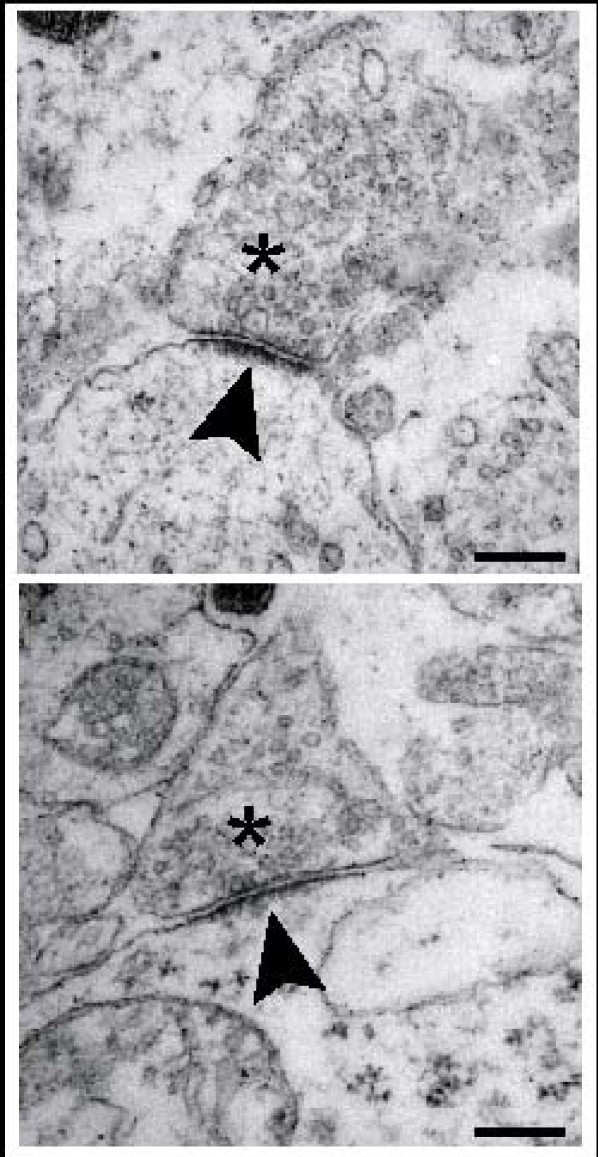
Postsynaptic density, Katharina Heupel et al,Postsynaptic density, CC BY 2.0
Whenever you need us, we are here for you!
Your BodyLab team, your connective tissue specialists
osteopathy and Physiotherapy | Rehabilitation and Training
Zurich Altstetten
You can find out more about this on our chronic pain page.
Featured Image Credit
Savant-fou, Synapse neuro-neuronale, CC BY-SA 3.0
"}